READ MORE \| Innovative Materials Revolutionizing the Construction Industry
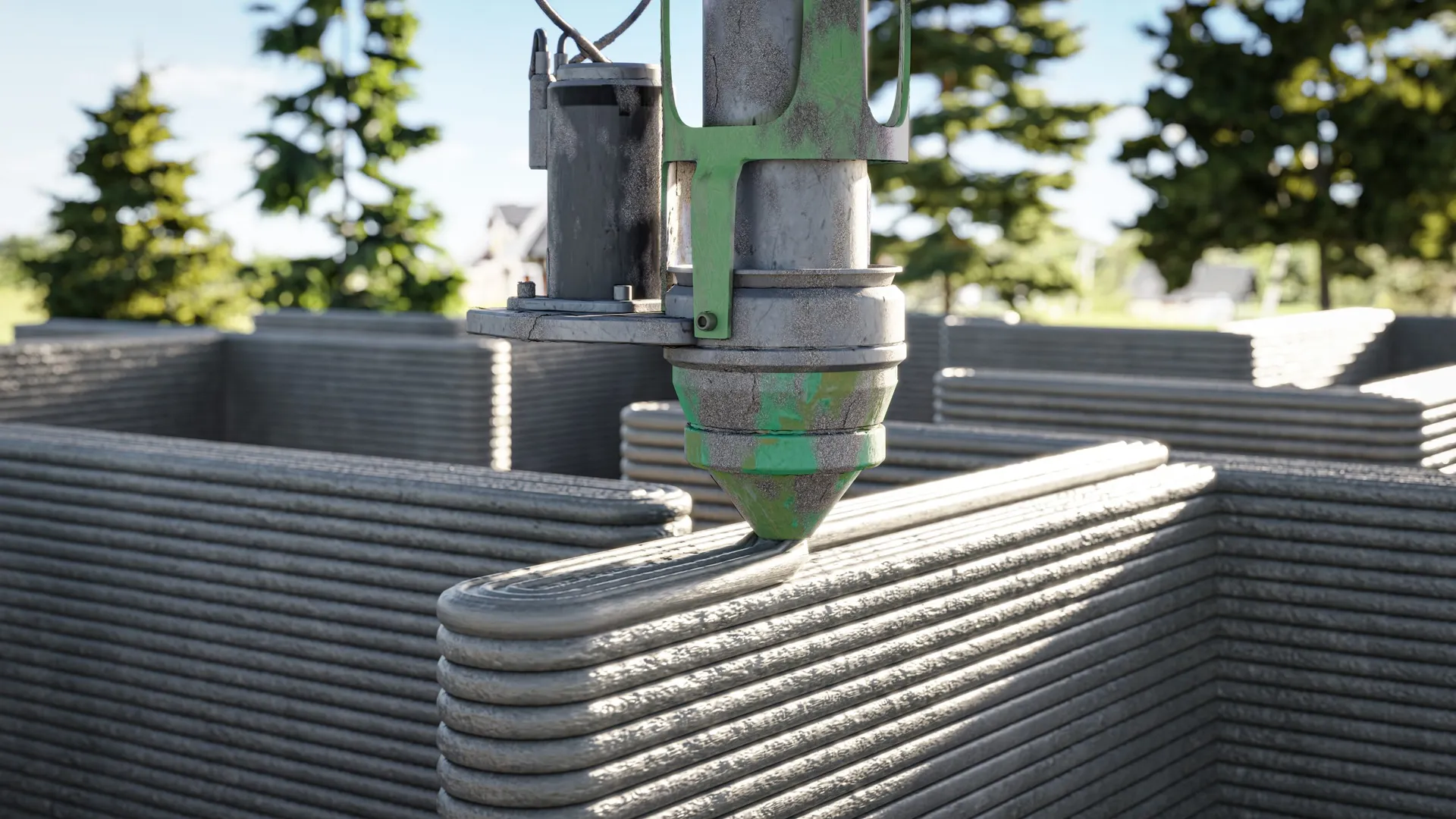
3D printing has been a quickly growing concept, and has become more and more important in the future on commercial construction. Involving the use of a large-scale printer, the process deposits layers–like concrete–to build a structure. 3D printing allows for more intricate designs made of sustainable materials in a shorter period of time.
Through the Ages
Where does 3D printing fit in with the history of commercial construction? In the mid-1980s, the idea was conceived as stereolithography (SLA), or a high-powered laser that turns liquid resin into a solid. According to a Digital Builder Blog editor Grace Ellis, SLA is still one of the most popular 3D printing technologies as it brought forth an additive, layer-by-layer quality for construction.
Initially, 3D printing was only used for building prototypes. It wasn’t until the adoption of building information modeling (BIM) that 3D printing was used in larger projects. Ellis provides a quick evolutionary timeline:
- 2004: USC professor attempts to 3D print a wall; considered as the technology’s first official entry into construction.
- 2014: A full, 3D printed canal house was built in Amsterdam.
- 2016: 3D-printed mansion built in China.
- 2016: The Dubai Future Foundation built its “Office of the Future” through 3D printing. In just 17 days, the fully functioning office was built to the size of 2,700 square feet.
Today, 3D printing and the construction industry become further and further intertwined, particularly when it comes to the use of concrete. In 2017, one of France’s top construction firms, Vinci, bought a stake in XtreeE, a French startup that specializes in 3D printing concrete structural elements. In 2019, Europe’s first concrete printing center was opened in the Netherlands.
Benefits
Other than the novelty of being able to print architectural structures, 3D printing has a treasure trove of benefits to be considered. For starters, the concept sources materials locally, reducing the construction industry’s carbon footprint, says the Florida Building Material Alliance (FBMA). Additionally, new technologies in 3D printing work more rapidly than traditional building methods, meaning communities can rebuild faster after natural disasters.
3D printing also allows for a certain amount of freedom when it comes to architectural design. “Architects are able to build complex designs that are otherwise unattainable, or too expensive or labor-intensive to create by conventional construction means,” notes Ellis. “This can allow for a lot more innovation and creativity in the commercial construction space.”
Another benefit to 3D printing is worker safety. According to OSHA, there were more than 5,000 fatal work injuries in 2023. That’s 3 ½ fatalities per 100,000 full-time workers. With the development of 3D printing, however, this number would likely decrease that number due to a more programmable and automated building process.
Challenges
Although there are significant benefits to the 3D printing process that bring high hopes for the future of the construction industry, it is still a work in process. The biggest challenge the technology faces is being less accessible than other building methods due to its higher financial cost. 3D printers are costly, and on top of that, equipment must be rented or purchased to transport the large printers to the work site. Many construction professionals have difficulty justifying the cost over the benefits.
Labor shortage is another major problem to consider, as there are currently not enough skilled workers to accommodate the booming construction industry. On top of that, 3D printing requires a niche set of skills the average construction worker might not have yet. These workers are needed, especially since 3D printing needs to be closely monitored by real humans to avoid technological errors. Ellis also points out that using 3D printers rather than humans could create a liability issue, as there are currently no clear-cut regulations around the technology.
Visit our Contact page to start a conversation with a construction professional today.
Notifications